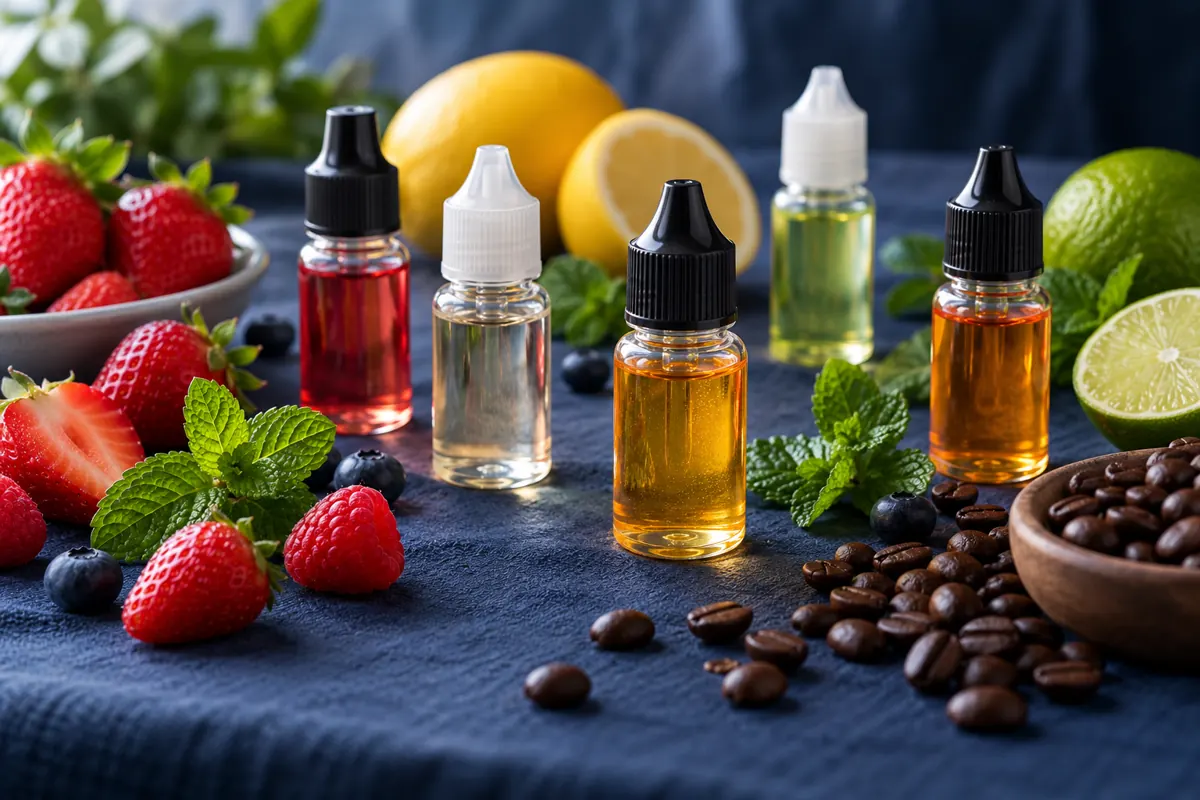
Faced with a wall of bottles, choosing an e-liquid can quickly feel like a puzzle. Fruit, dessert, menthol, tobacco, behind each family sit dozens of variations that change the result entirely. Shop listings group vape flavours by type, but rarely explain what separates one profile from another or why the same recipe tastes different from one kit to the next. How do you find your way, and how do you spot the profile that genuinely suits you?
Vape flavours fall into four main families
Vape flavours sort into four main families, fruit, dessert, menthol and tobacco. Each one answers a different expectation, from light and fresh to rich and sweet. Knowing these markers is enough to steer your first choices without getting lost, then refine as you go.
Around these four poles sit blends and drink-inspired recipes, which borrow from several families at once. A single profile can be declined almost endlessly, which explains why one UK shop can list more than two hundred references under a single heading.
Fruit flavours, the widest family
Fruit recipes cover everything from strawberry and mango to citrus and orchard fruit. They are often the first family new vapers look at, because the reference point is familiar and the profile reads clearly.
Within the family, the split that matters most is between straight fruit and fruit with a cooling note, and between a single fruit and a blend. Citrus deserves a mention of its own, since lemon, lime and their varieties behave very differently, as our guide to lemon e-liquid explains.
Fresh fruit or iced fruit
Fresh fruit recipes aim for a natural, rounded taste. Iced versions add menthol or a cooling agent, which sharpens the draw and pushes the fruit into the background. Among vape flavours, iced fruit is easy to spot on UK shelves, where some ranges offer an iced version of almost every fruit.
Single fruit or blend
A single-fruit recipe is the easiest way to learn what you like. Blends layer two or three fruits, often with one sweet base and one sharper note on top. They are more complex, and also harder to judge if you do not yet know each fruit on its own.
Dessert and bakery flavours
Vanilla, custard, biscuit, caramel, pastry, dessert recipes are the richest family. They rely on heavier flavourings and, very often, on added sweetener, which gives them their roundness.
That richness has a practical consequence for your hardware. Sweet recipes leave more residue on the coil, so the wick darkens faster and flavour fades sooner than with a straight fruit or a menthol. Dessert profiles also tend to gain balance after a few days of rest in the bottle, a process vapers call steeping.
Menthol, mint and tobacco flavours
These two families sit apart from the rest. One aims for a clean, cool sensation, the other for warm, dry notes, and both appeal to vapers who prefer a simpler profile.
Menthol and mint
Menthol brings a sharp, cooling sensation, used alone or paired with fruit. Mint recipes are softer and more aromatic, with spearmint and peppermint each giving a different edge. Some recipes add a cooling agent alongside menthol, which strengthens the cool effect without adding a mint taste.
Tobacco-style flavours
Tobacco-style recipes set out to recreate warm, dry, sometimes nutty notes. Results vary widely between brands, from light blond profiles to darker blends with caramel or nut layers. These vape flavours are among the hardest to get right, which explains the gap between ranges.
How vape flavours are built
Every e-liquid shares the same basic structure, a base of propylene glycol (PG) and vegetable glycerine (VG), flavourings, and nicotine or not. Understanding that structure helps to read any label.
PG is thin and carries flavour well, while VG is thicker, with a slight natural sweetness, and produces denser vapour. Many 10ml nicotine bottles use a 50/50 ratio, whereas large shortfills are usually high in VG. A high-VG shortfill and a 50/50 bottle of the same flavour will therefore not taste identical, even before the hardware enters the picture.
The UK also sets limits on what goes into nicotine e-liquid. Government guidance on vaping products for consumers states that certain ingredients are banned, including colourings, caffeine and taurine. A drink-inspired recipe on a UK shelf can borrow a flavour profile, but not those ingredients.
Reading a flavour description on the bottle
Product pages and labels use a small vocabulary that is worth decoding before choosing. Once you know it, two bottles from different brands become much easier to compare.
Notes, layers and cooling terms
Some makers describe a recipe in layers, borrowed from perfumery. Alfaliquid, for instance, presents its Lemon Ice with lemon and lime as top notes, spearmint at the heart and menthol with a cooling agent at the base. The top note is what you notice first, the base what lingers. Terms such as "ice", "cool" or "frost" generally signal menthol or a cooling agent rather than a separate fruit.
What the ingredient list adds
On nicotine e-liquid sold in the UK, regulation 37 of the Tobacco and Related Products Regulations 2016 requires all ingredients to be listed in descending order by weight. A sweetener such as sucralose will therefore show up on the pack, and some makers now state its absence on the product page. For anyone who finds dessert and fruit recipes too sweet, that line of the label is the quickest filter.
How your hardware changes the taste
The same bottle can taste muted in one device and vivid in another. Coil resistance, power and airflow all shape how a flavour comes through.
A tight mouth-to-lung pod at low power gives a concentrated draw, which suits sharp profiles such as citrus and mint. A direct-to-lung tank with open airflow and higher power produces more vapour, the setup that high-VG dessert and creamy recipes are generally designed for. To compare these two approaches in detail, see our guide to choosing between a pod or box mod.
Coil condition matters as much as the format. A coil clogged by sweet residue dulls every flavour, so a recipe that suddenly tastes flat is often a sign that the coil needs changing rather than that the liquid has changed.
Finding your profile among vape flavours
Start with one family, try two or three variations within it, then adjust the ratio and strength to your kit. This method keeps comparisons fair, because only one variable changes at a time.
Patience pays off more than a long list of bottles. Exploring vape flavours is mostly a question of curiosity and of reading labels carefully, with no universal rule, and the right profile is simply the one that suits your palate and your hardware.
FAQ
A few questions come up regularly once you start comparing flavours. Here are short answers.
Which flavour family is easiest to start with?
A simple fruit or a light tobacco-style recipe is often a good starting point. Their profiles are easy to read, which makes it simpler to tell whether you like the family before moving on to blends.
Why does a familiar flavour sometimes taste weaker?
Many vapers describe a temporary dulling of flavour perception after using the same profile for a long period, often called vaper's tongue. A clogged coil produces a similar effect, so it is worth checking the coil first.
Should a new e-liquid be left to steep?
Fruit and menthol recipes are usually ready as soon as they are opened. Dessert and tobacco-style recipes can gain balance after a few days in a cool, dark place, with the cap closed.
Does a shortfill taste the same as a 10ml bottle of the same flavour?
Not always. According to UK maker IVG, shortfills are usually formulated a little stronger so the flavour holds once a nicotine shot is added, and they are usually high in VG, which can soften sharper notes.
Do flavourless e-liquids exist?
Yes. Some UK shops list unflavoured e-liquids, made only of PG, VG and, where chosen, nicotine. Among other uses, they serve as a base for people who mix their own recipes from flavour concentrates.
Choosing among vape flavours with a clear method
Four families, a handful of blends, and a base whose ratio changes the result, that is the whole map. Fruit for clarity, dessert for richness, menthol for coolness, tobacco for warmth, each family has its logic, and the label tells you most of what you need to know. Read with your hardware in mind, vape flavours become far less of a puzzle, and the wider world of e-liquid becomes easier to explore with confidence.
Related reading
- Vape culture, how a device built its own codes and communities
- Best pod 2026, our selection and criteria
Independent editorial content for adults only, not a recommendation to buy. Vaping products can contain nicotine, which is a highly addictive substance. Nicotine vaping products are not for sale to anyone under 18 in the UK.